Overview: Executive Primer on Enterprise AI (Long)**DRAFT**
By Paul M Hinz

DRAFT
Outline:
The Business Value of AI
The Impact of AI on IT
The Impact of AI on Society
The Impact of AI on Government Ops
The Dangers to Avoid
Timeline of AI Technology
What is Artificial Intelligence?
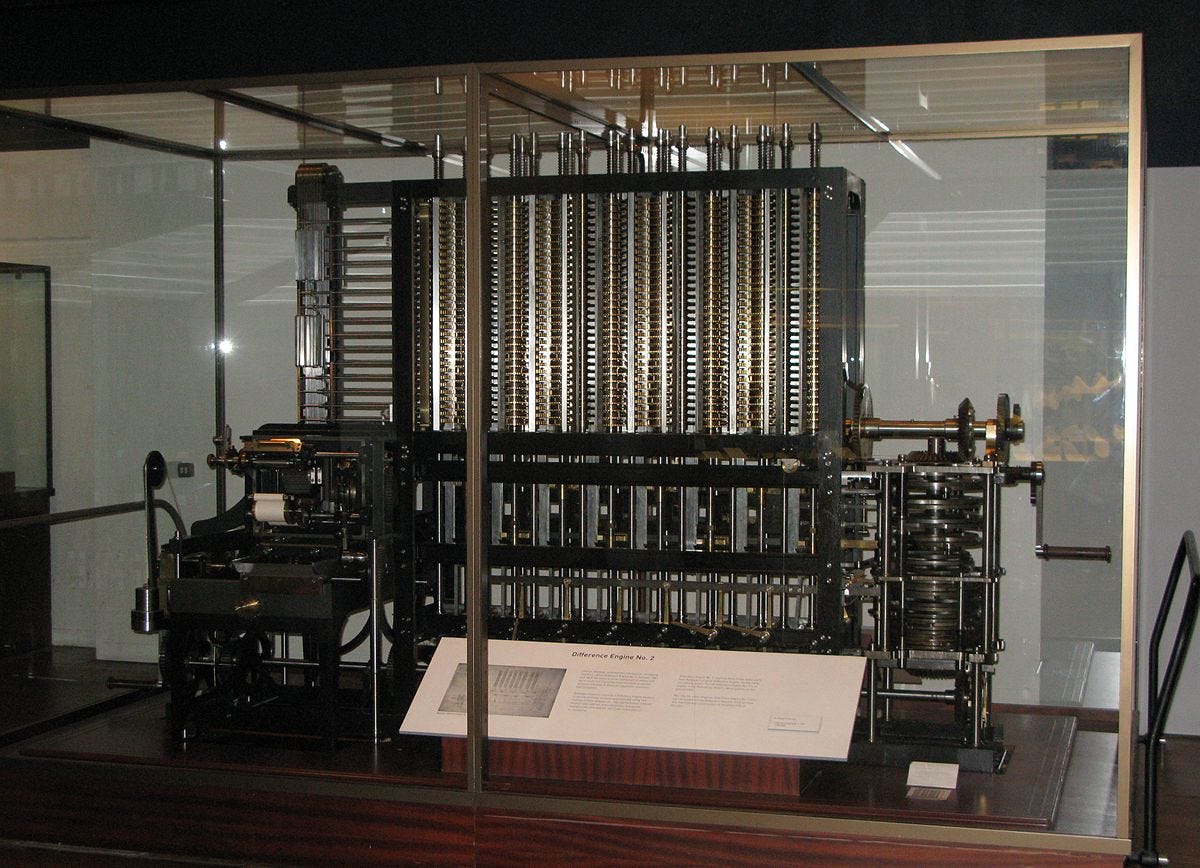
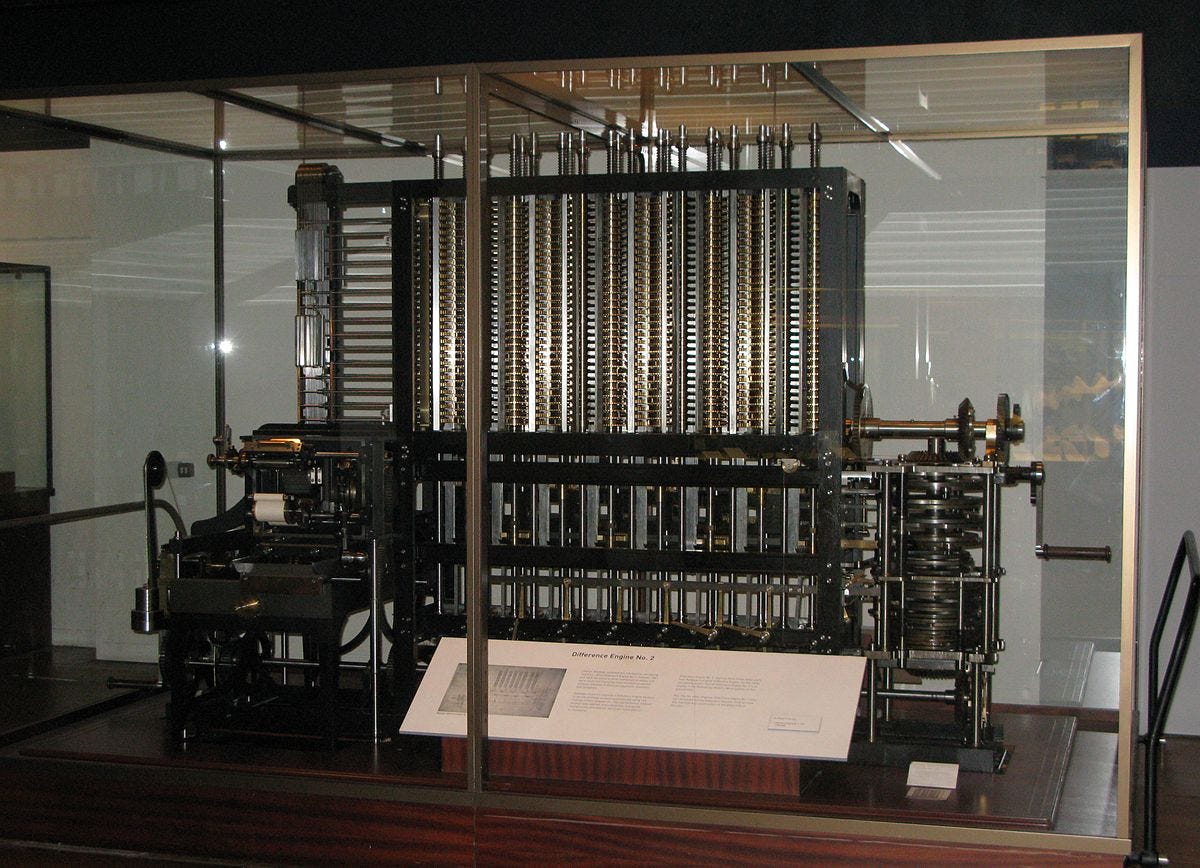
1837: Charles Babbage designed the Difference Engine, an early mechanical computer.
Early computers used gears and mechanical parts for calculations, later evolving to use radio tubes, transistors, and microprocessors, making them faster and “smarter”.
1842: Ada Lovelace, “Computers can only do what we program them to do.”
Today, AI can do what we program, what we teach it, and what it can learn on its own.
Marvin Minsky, MIT, introduced “suitcase words” for broad terms like “intelligence.”
Consistently experts predict human-level “intelligence” is 15-20 years away, but we're still not there.
Patrick Winston, MIT, defines intelligence as: “Thinking + Perception + Action.
1950-1960s: The First AI Wave
1950: Alan Turing proposed the Turing Test to see if a machine can act like a human.
1956: John McCarthy coined the term “Artificial Intelligence.”
1956: Allen Newell and Herb Simon created "The Logical Theorist," the first AI program.
1958: John McCarthy introduced the LISP programming language for AI research.
1959: Marvin Minsky and John McCarthy found the MIT AI lab for global research.
1961: Minsky published “Steps Towards Artificial Intelligence,” discussing different AI methods.

MIT AI Laboratory, Credit Mind Hacks
1970s and The First AI Winter
1961: UNIMATE, the first industrial robot, was used at General Electric.
1966: ELIZA, an early chatbot, could have simple conversations.
1966: Shakey, the first mobile robot, could navigate its environment using AI.
1967: LOGO programming language and Turtle robot allowed kids to code.
1970: Interest in AI decreased due to slow progress, leading to the first “AI Winter.

Turtle Robot, Credit: Seymour Papert, Digital Learning and Missed Opportunities
1980s-1990s and The Second AI Wave
Focus shifts to knowledge representation, how AI can understand and use information.
1979: MYCIN program was able to diagnose infections as well as human doctors.
1980: Wabot-2, a robot, could read music and play an organ.
1983: Home computers became popular, and robots were used more in industries.
Late 1980s: AI faced another “winter” due to slow progress

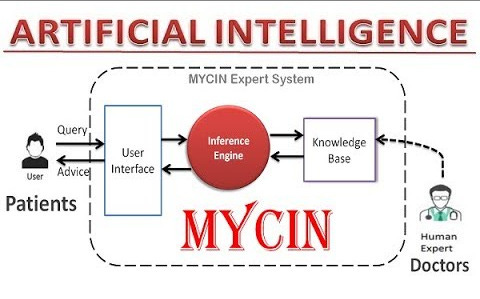
MYCIN Architecture, Credit: MYCIN an Expert System
1987-1993 and The Second AI Winter
Neural networks were mostly abandoned but revived in 2006 by Geoffrey Hinton’s image classification application, the first successful neural network
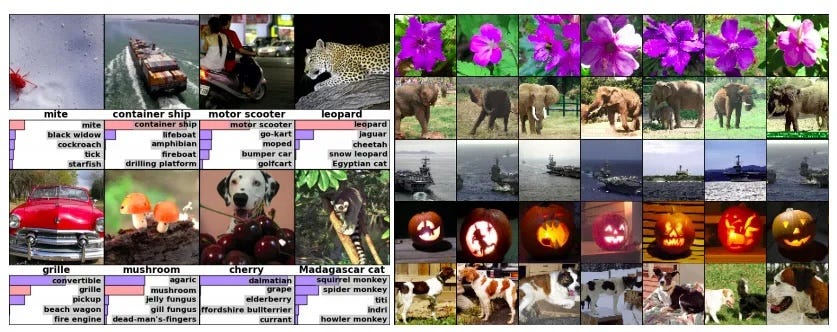
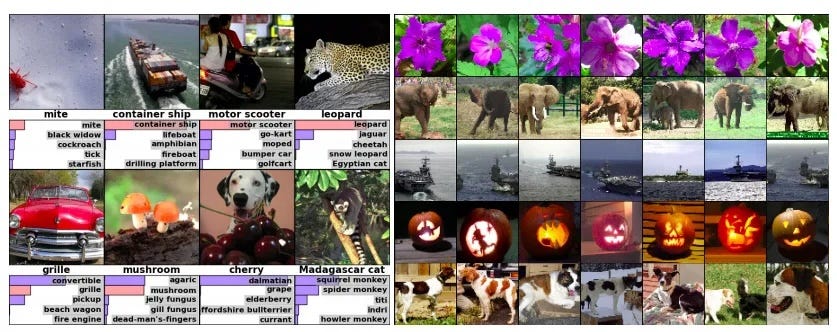
Image Classification Neural Network, Credit Krizhevsky, Sutskever, Hinton
2006 - Present: The Third AI Wave
1997: Deep Blue beat chess champion Garry Kasparov.
2006: Deep learning became a key technology for AI.
2011: IBM’s Watson won Jeopardy!, and Siri was released on iPhones.
2015: AlphaGo defeated the world champion in the game Go.
Modern AI includes machine learning and neural networks, allowing computers to learn from structured (tables with labeled columns and rows) and unstructured data.
Key drivers of the recent AI wave:
general-purpose AI tools like ChatGPT,
powerful computing using graphics processors like Nvidia,
massive investment in AI startups,
and strong demand for new business solutions using AI.
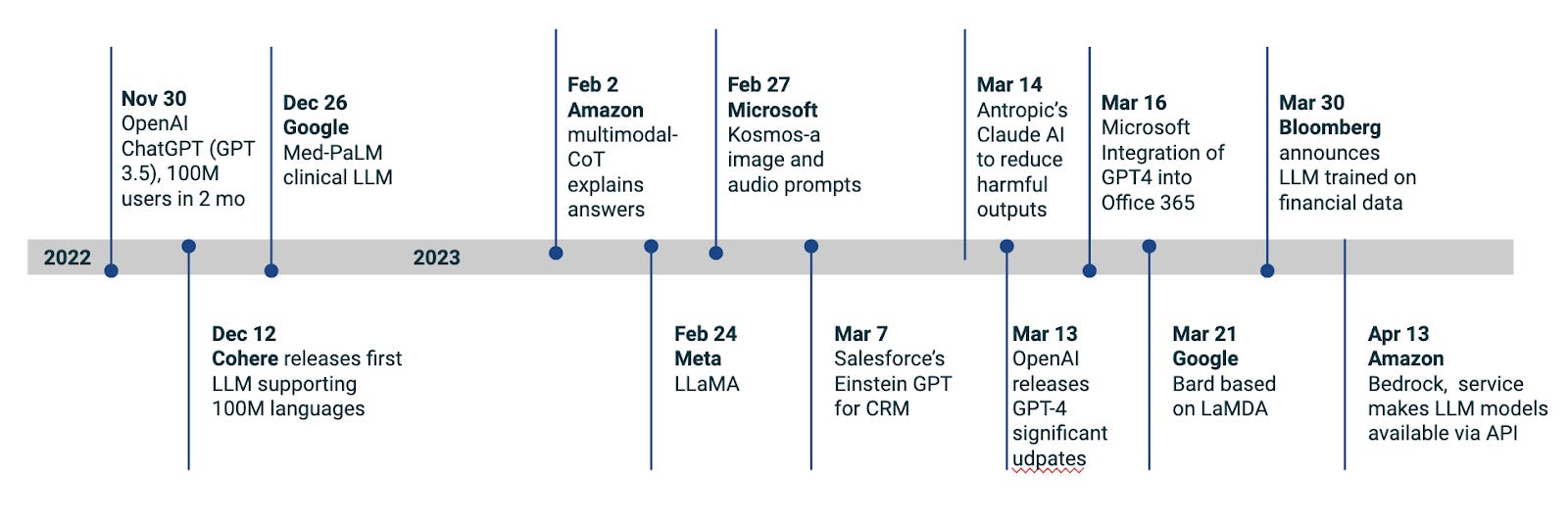
Timeline of major LLM development since ChatGPT: Credit McKinsey Digital
The Fourth AI Wave: The Future
AI could help us understand new types of intelligence beyond human capabilities.
Businesses may drive the next AI wave, focusing on improving efficiency and innovation.
Understanding human uniqueness, like the ability to merge ideas, could lead to advanced AI applications.
Future AI might involve different types of AI working together with human intelligence.
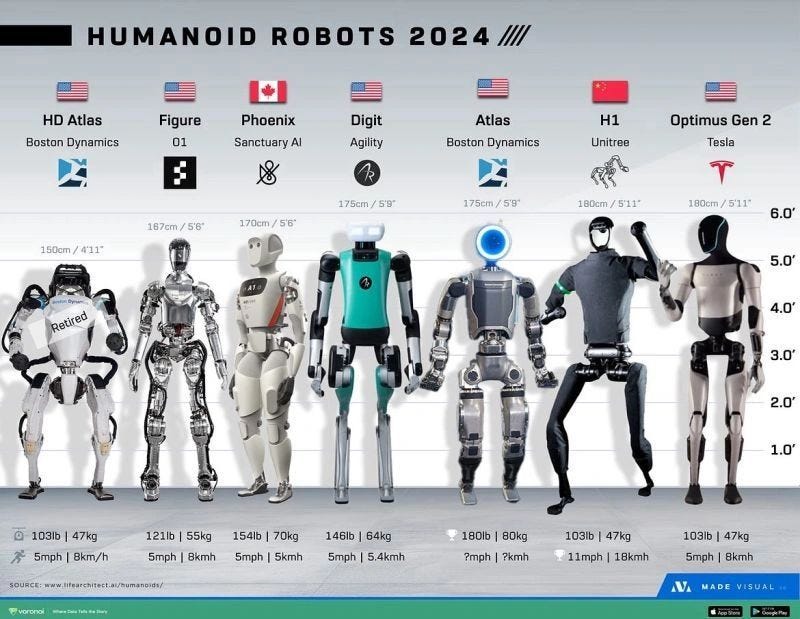
Major robotic projects 2024, Credit: Humanoid Robots Ready for LLMs
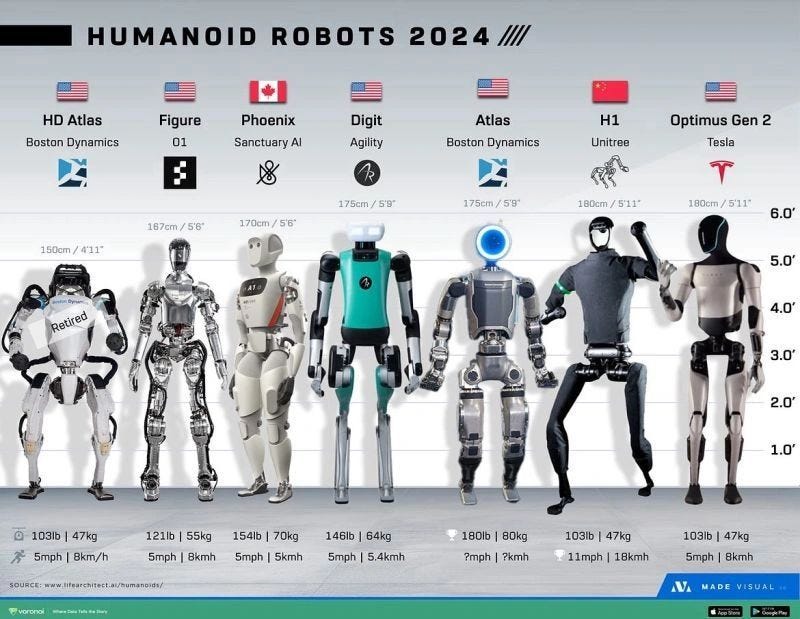
Executive Overview of AI Technology
Artificial Intelligence (AI)
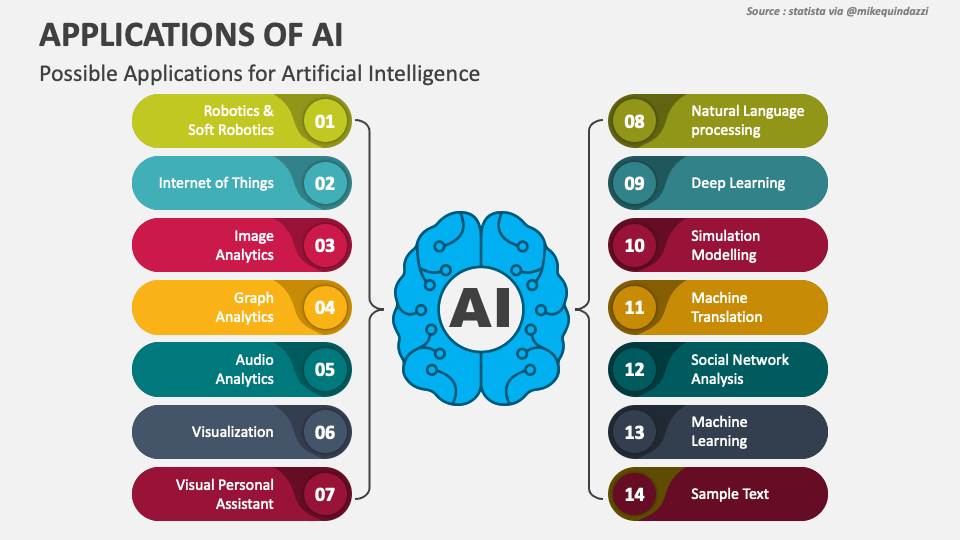
Image Credit: 18 Cutting-Edge Artificial Intelligence Applications in 2024
Definition
AI is a part of computer science, data science, mathematics, and other engineering disciplines that focus on creating machines that can think and learn like humans.
Prof Malone of MIT stated AI is defined by: “ Architectures that deploy methods enabled by constraints exposed by representations that support models of thinking, perception, and action. “
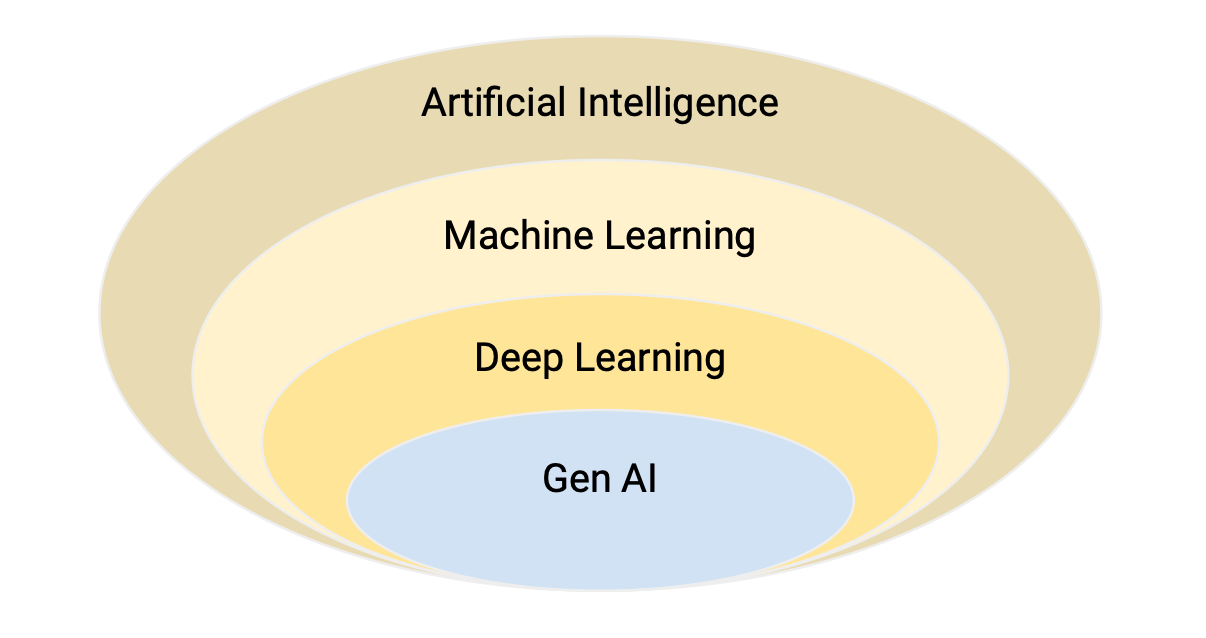
Hierarchy of AI Technologies: AI is a set of technologies that can be defined together as follows:
Artificial Intelligence (AI): The broad field that includes all intelligent machines.
Machine Learning (ML): A method within AI that teaches computers to learn from data.
Deep Learning (DL): A more advanced type of ML that uses neural networks to process data in multiple layers.
Natural Language Processing (NLP): A branch of AI that helps computers understand and generate human language.
Large Language Models (LLMs): Advanced NLP tools that use deep learning to create human-like text.
Robotics: Combines machines with AI to help machines interact with their environment and perform tasks.
Categories of AI: AI ranges from simple systems that follow rules to more advanced ones that learn and adapt, tackling everything from basic image recognition to complex tasks like autonomous driving.
Narrow AI:
Designed to perform one specific task very well.
Examples: Siri, Alexa, Google Assistant (follow voice commands) and image recognition tools (identify objects in photos).
Reactive AI:
Reacts to situations but doesn’t learn from past experiences.
Examples: Chess programs that only respond to moves and spam filters that block unwanted emails.
Limited Memory AI:
Limited Memory AI learns from past experiences to make better decisions.
Examples: Self-driving cars (remember routes) and chatbots (improve responses over time).
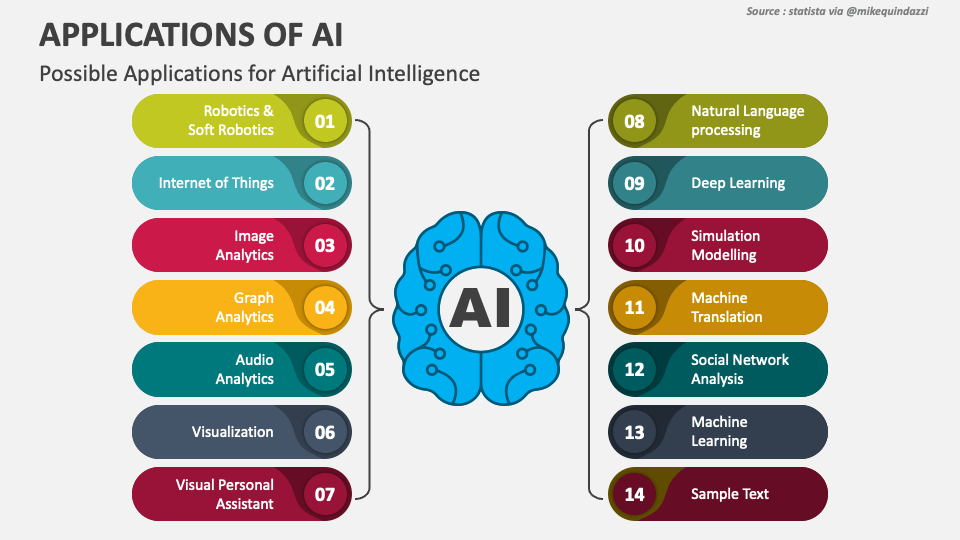
Machine Learning (ML)
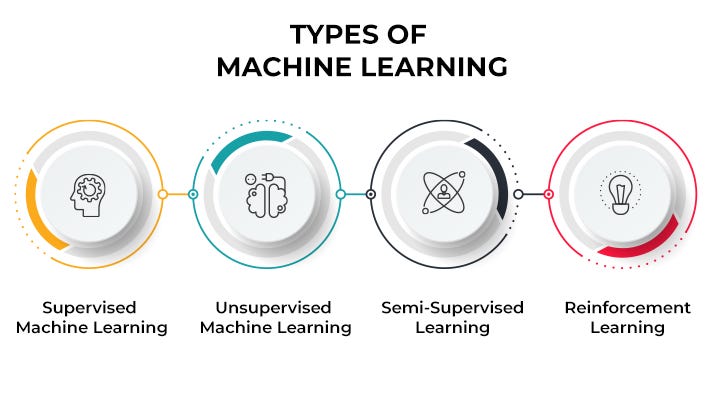
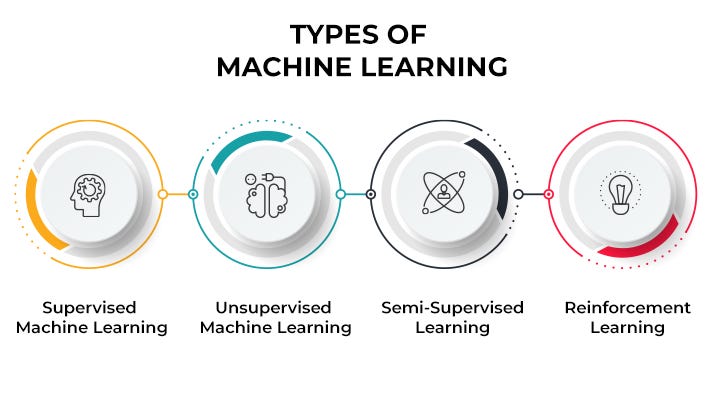
Image credit: What Is Machine Learning? Def, Types, Apps, and Trends
Definition
Machine learning is when computers learn from examples, just like people do.
For instance, to teach a computer to recognize dogs, you show it many labeled pictures of dogs until it can identify a dog in new pictures on its own.
This works using neural networks, which help the computer find patterns in the data.
How Does Machine Learning Work?
Machine learning uses algorithms (special programs) to analyze large amounts of data and find patterns.
These patterns help the computer make predictions, like suggesting what you might want to buy based on your past purchases.
The more data it sees, the better it gets at making predictions.
However, some things, like predicting chaotic events (e.g., asteroid movements), are much harder for ML to learn.
Types of Machine Learning
Supervised Learning:
The computer is trained with labeled data (e.g., pictures labeled “dog”).
It learns from mistakes and gets better at predicting new, similar data.
Semi-Supervised Learning:
Uses a mix of labeled and unlabeled data.
The computer learns from the labeled data and applies this knowledge to understand the unlabeled data.
Reinforcement Learning:
The computer learns through trial and error, like playing a game.
It tries different actions and learns which ones give the best results over time.
Unsupervised Learning:
The computer gets data without any labels or guidance.
It finds patterns on its own, like grouping similar objects together.
Examples of Machine Learning
Medical Diagnosis: Helps doctors find diseases by spotting patterns in medical data.
Playing Games: Computers can play complex games like chess or Go by evaluating many possible moves.
Personalized Recommendations: Websites like Netflix or YouTube suggest shows and videos based on what you've watched.
Search Engines: Google uses ML to predict what you’re looking for and provide the best results.
Chat bots: Virtual assistants get better at answering questions the more they interact with people.
Machine learning allows a computer to develop applications that can learn from data, make predictions, and improve predictions, making it useful in many everyday applications.
Neural Networks

Image Credit: Nerual Newtork Zoo
Definition
Neural networks are computer models inspired by how our brains work.
Our brains have billions of cells called neurons that help us think and learn.
Each neuron has three parts:
Dendrites: Receive information
Soma: Processes the information
Axon: Depending on thresholds, transmits information to the next neuron
There are multiple neural network types (see below) that use connected units (like neurons) to process information and train algorithms.
How Do Neural Networks Work?
Each unit (neuron) in a neural network receives input (data) and decides whether to send a signal to the next unit.
This decision depends on the strength of the input, controlled by weights (w) and thresholds (t).
If the input is strong enough, the neuron activates; if not, it stays quiet.
When many units work together, they can solve complex problems, like recognizing faces in photos or predicting weather patterns.
Neural networks are trained with data (like labeled images of cats and dogs) to learn patterns and make accurate predictions.
Backpropagation is a technique used to train neural networks by helping them learn from their mistakes. When the network makes a wrong prediction, backpropagation calculates the error and sends it back through the network, adjusting the connections (or weights) between neurons.
Types of Neural Networks
The “mostly complete map of Neural Networks”: Compiled by Fjodor van Veen, and posted to blog on the Asimov Institute (linked here).
Some example types:
Feed forward neural networks (FF or FFNN) feed information from the front to the back (input and output, respectively).
Recurrent Neural Networks (RNNs): Good at remembering past information, like the previous words in a sentence. Used in chatbots and language translation to understand context.
Generative Adversarial Networks (GANs) leverage a pair of competing networks, one network generates content, while the other judges if the content is real or fake. The judging network gets better at telling the difference, while the generating network learns to create more convincing content. This "competition" makes both networks improve.
Convolutional Neural Networks (CNNs): Experts at analyzing images and videos by looking at small details like edges and corners. Used in facial recognition, self-driving cars, and apps that identify animals or objects in photos.
Self-Organizing Neural Networks: Can organize themselves and learn new patterns without being told how. Used to spot trends in data, like detecting unusual body movements or analyzing medical data.
Example Uses of Neural Networks
Healthcare: Help doctors diagnose diseases and recommend treatments by analyzing medical images or sounds.
Retail: Suggest products based on your shopping history and recommend music or movies you might like.
Transportation: Manage delivery routes and help self-driving cars navigate roads safely.
Neural networks are powerful tools that help computers learn and make decisions, just like humans. They are used in many fields and will play a big role in future technology.
Deep Learning (DL)
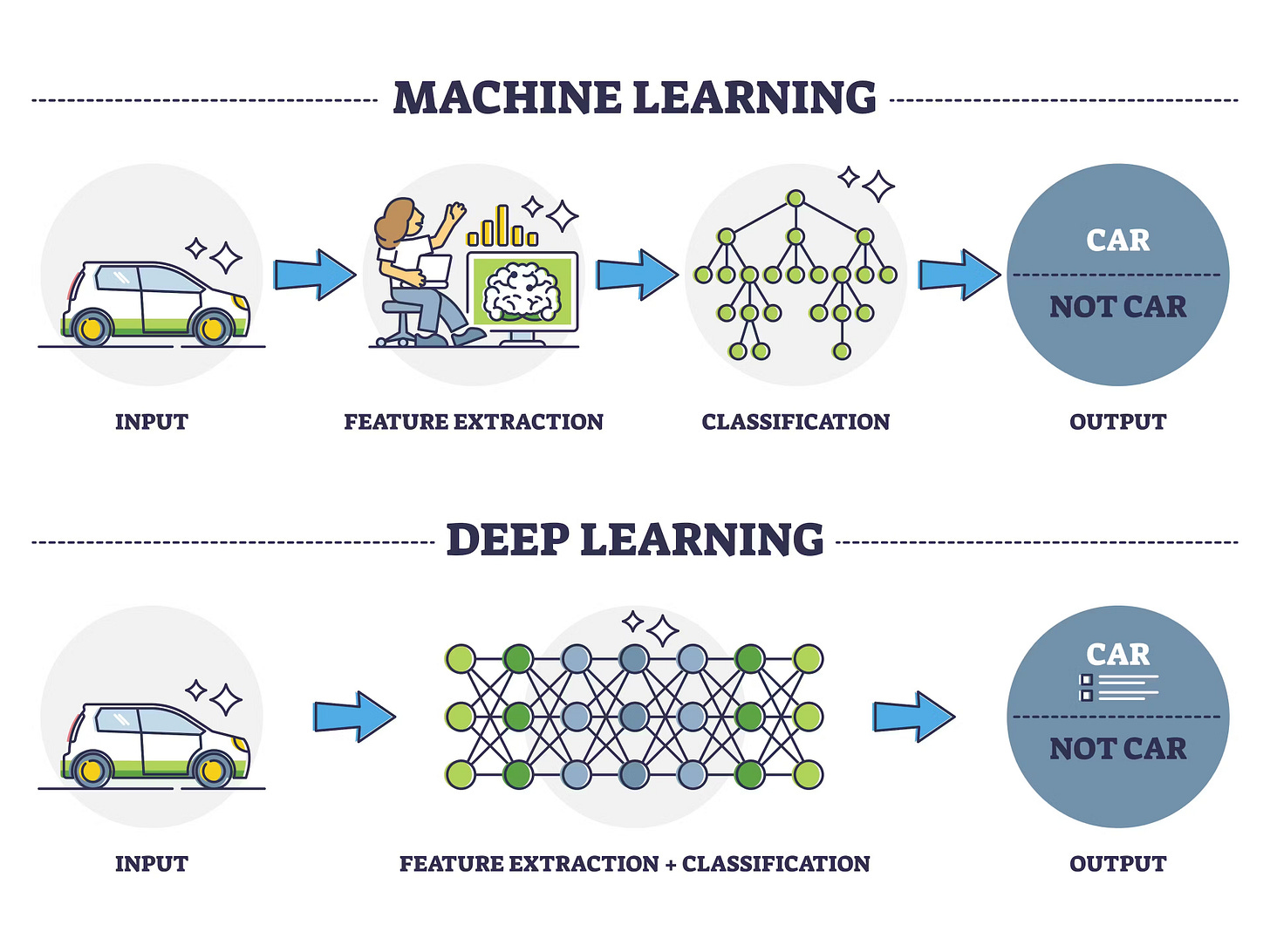
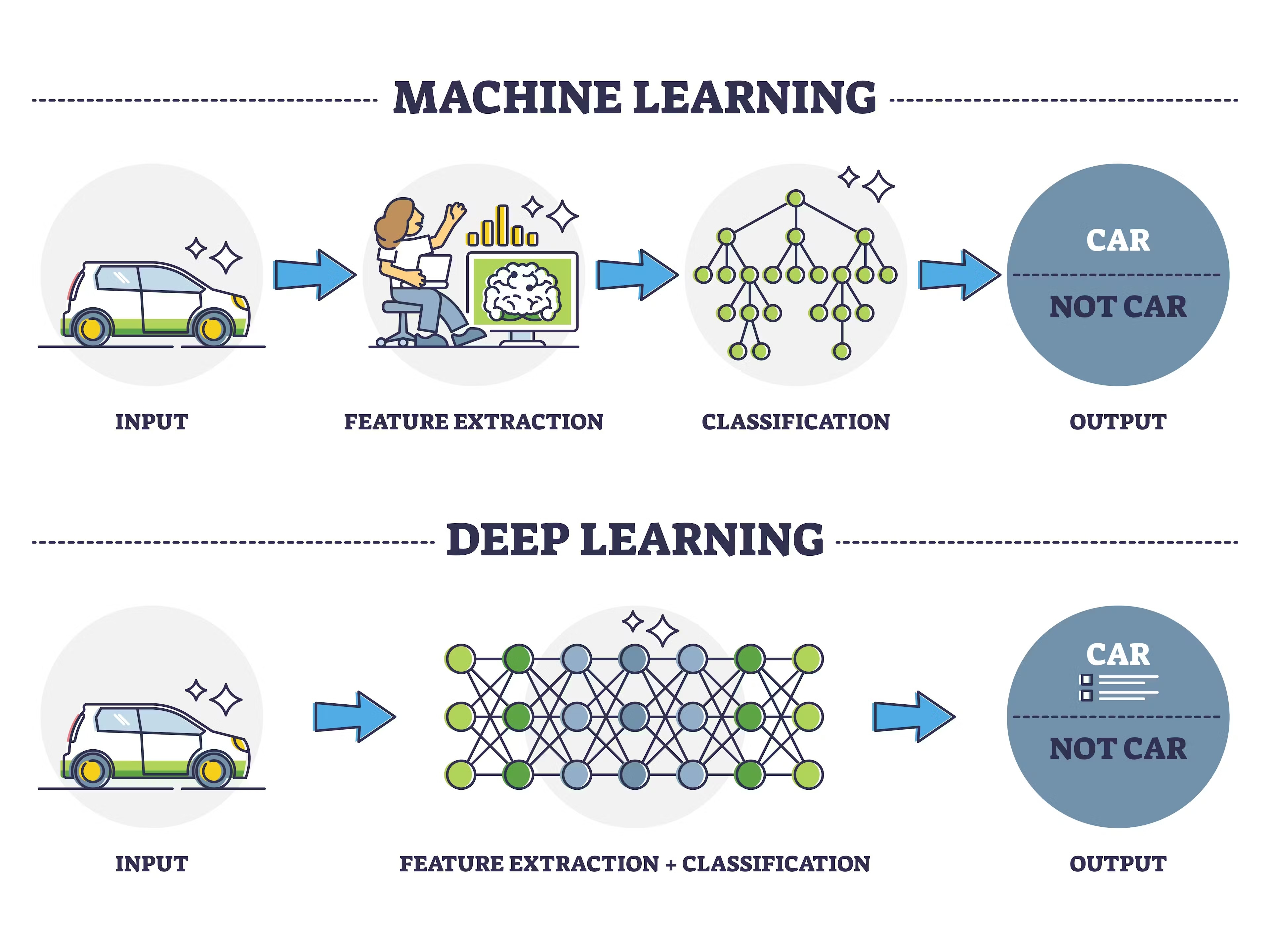
Image Credit: Deep Learning vs Machine Learning: The Ultimate Battle
Definition
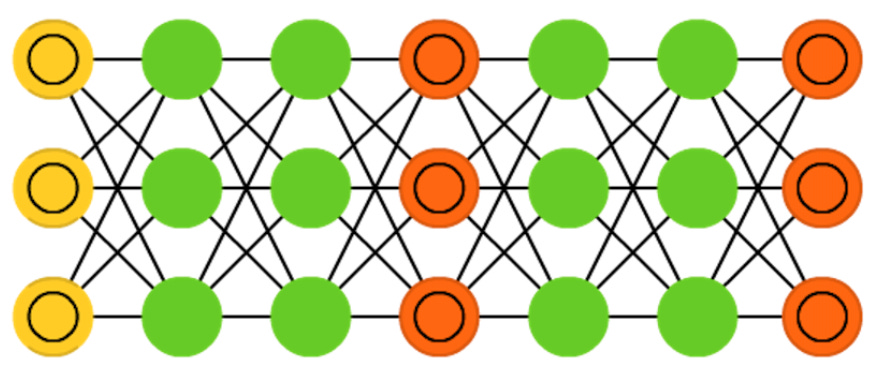
Deep learning is a type of machine learning that uses neural networks with 3 or more layers to learn from huge amounts of data.
More layers make the network smarter and more accurate, allowing it to handle complex tasks like recognizing faces in photos or understanding speech.
Deep learning has driven many of the recent breakthroughs in AI.
Differences Between Machine Learning (ML) and Deep Learning (DL)
Amount of Data Needed
ML: Can work with less data and still be useful, like identifying spam emails.
DL: Needs a lot of data to perform well, like understanding all the different ways people speak.
How They Learn
ML: Requires more human guidance, like labeling data as “cat” or “dog.”
DL: Can learn patterns on its own from messy data without as much human help.
Computing Power
ML: Works with a few layers and doesn’t need super powerful computers.
DL: Uses many layers and needs a lot of computing power and special hardware.
Time to Train
ML: Can be trained in a few hours because it’s simpler.
DL: Can take weeks to train due to the large amount of data it needs to process.
Type of Output
ML: Gives simple results like “spam” or “not spam.”
DL: Can produce complex results like recognizing speech, generating text, or creating images.
Examples of Deep Learning in Use
Self-Driving Cars: Helps cars understand the road and avoid obstacles.
Warehouse Robots: Picks and packs items accurately and quickly.
Financial Services: Predicts stock prices and helps make investment decisions.
Customer Support: Responds faster to customer questions and suggests solutions.
Law Enforcement: Analyzes crime data to predict and prevent problems.
Healthcare: Assists doctors in diagnosing diseases and choosing treatments by analyzing medical data
Deep learning is powerful because it can learn and improve over time, just like humans. It’s used in many areas, from smartphones to self-driving cars, making technology more helpful and connected to our daily lives.
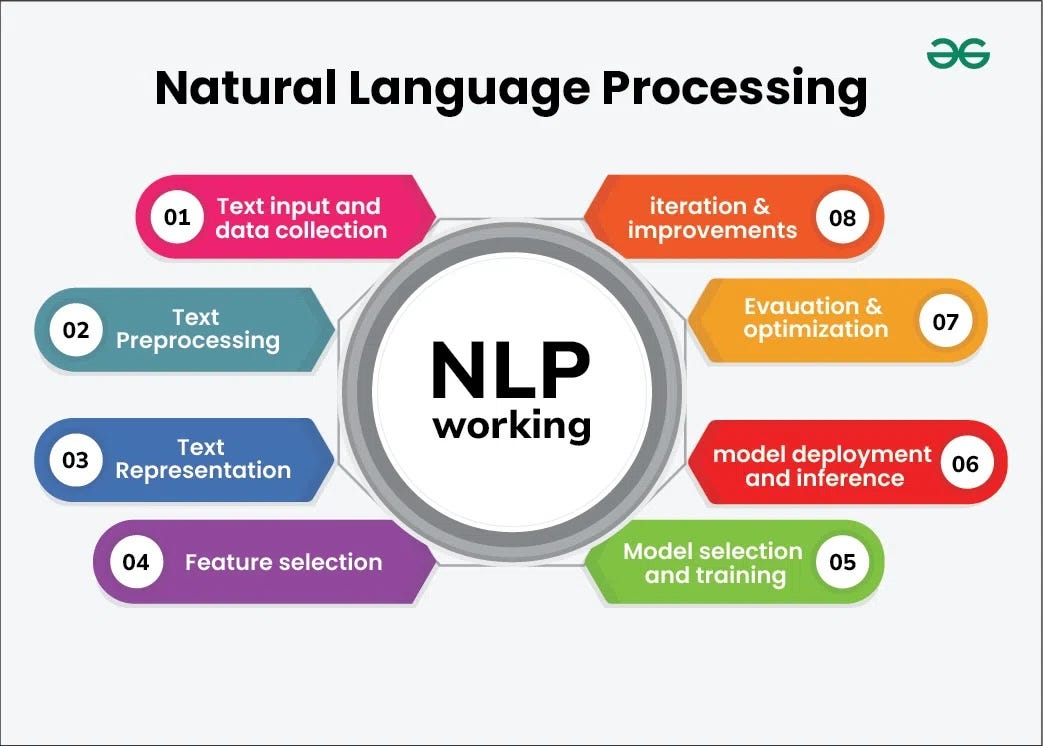
Natural Language Processing (NLP)
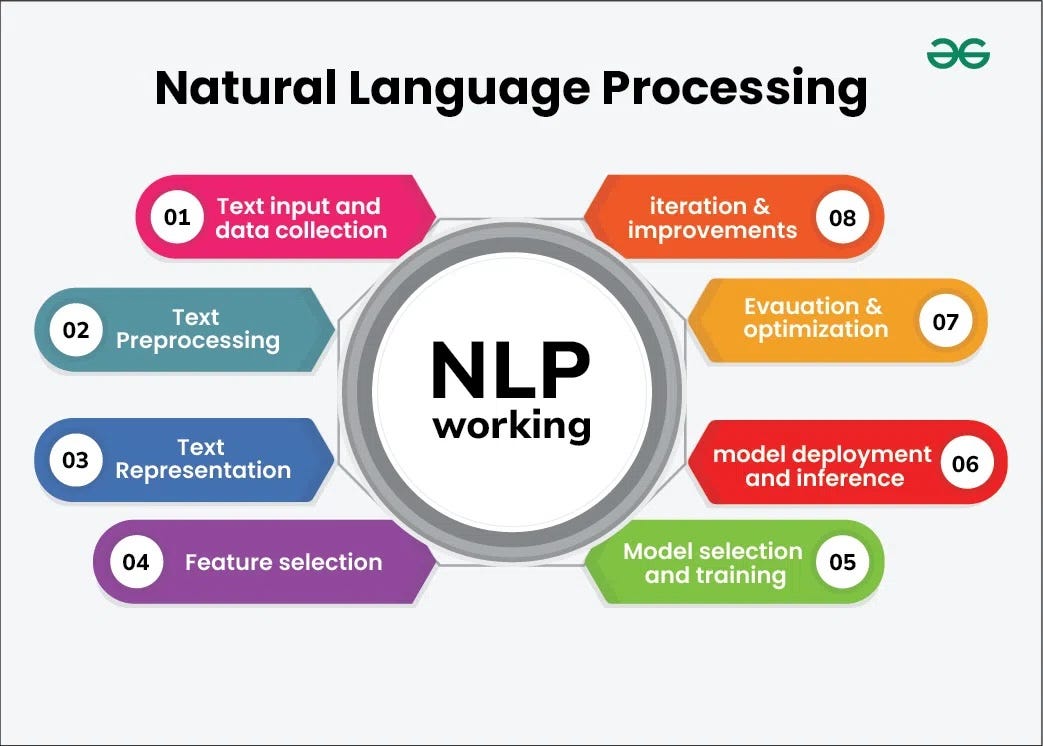
Image credit: Natural Language Processing (NLP) – Overview
Definition
Natural Language Processing, or NLP, is a part of AI that helps computers understand and use human language.
It’s like teaching computers to read, listen, and even talk back to us.
It’s used in things like Siri, Alexa, chatbots, and translation apps to help these tools understand what we say and respond appropriately.
How Does NLP Work?
NLP uses rules and mathematical techniques to understand the meaning of words and sentences.
It often relies on machine learning (ML) to learn from lots of examples, like reading millions of text messages.
Deep learning, a type of ML, helps NLP get better at understanding without much human help.
What Can NLP Do?
Summarize Text: It can read a long article and give a brief summary of the main points.
Check Grammar: It finds mistakes in writing and suggests corrections, like a spell-checker.
Analyze Sentiments: It can tell if a review or comment is positive, negative, or neutral.
Identify Names: It can recognize names of people, places, or companies in a text.
Examples of NLP
Voice Assistants: Siri, Alexa, and Google Assistant use NLP to understand and respond to your voice commands.
Chatbots: These are virtual assistants on websites that answer your questions or help solve problems.
Translation Apps: Apps like Google Translate use NLP to translate sentences from one language to another
NLP allows computers to understand and interact with human language, making it easier for us to communicate with them and get help in our daily tasks.
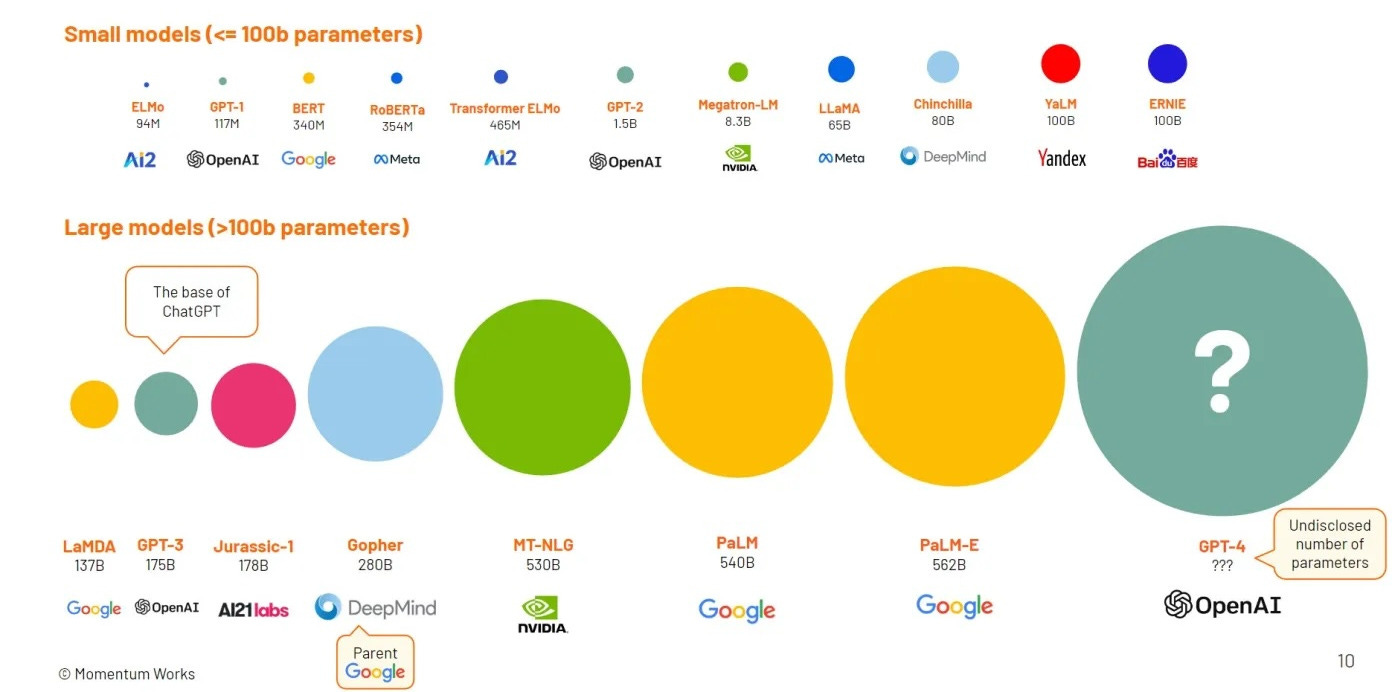
Large Language Models (LLM)
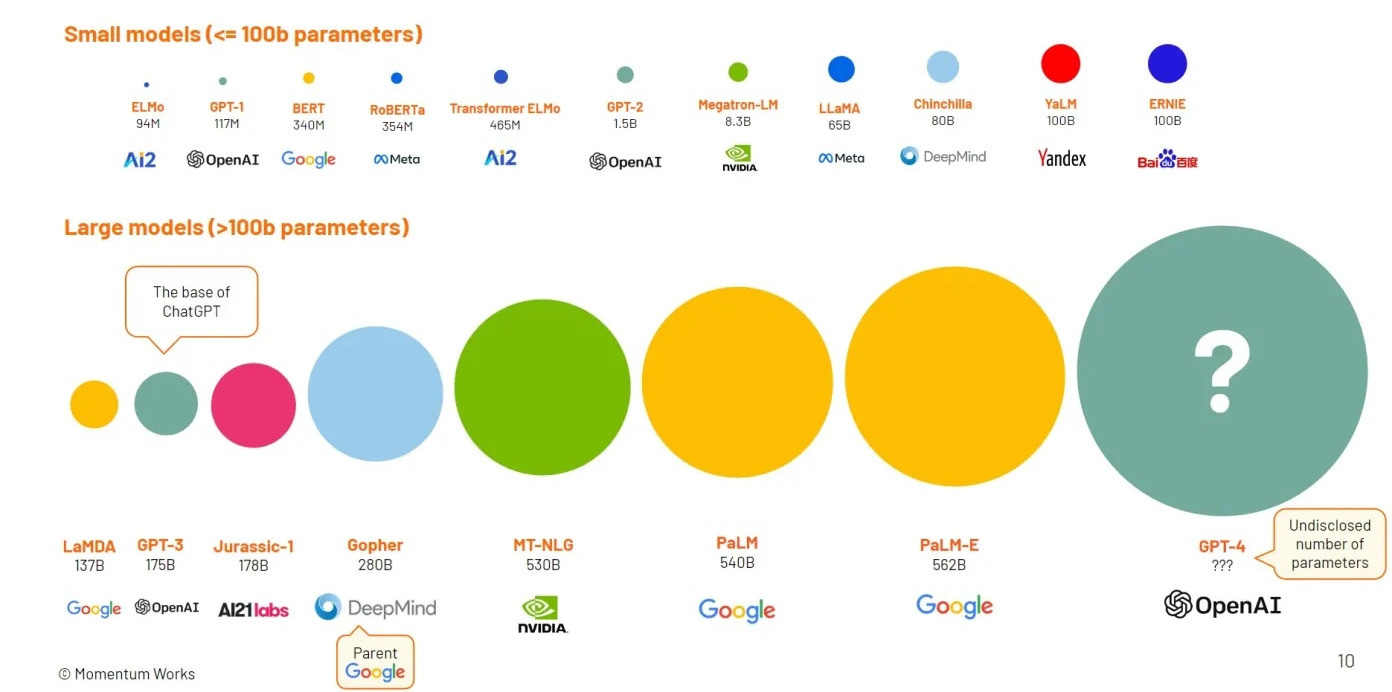
Image credit: The emergence of Large Language Models (LLMs)
Definition
Large Language Models (LLMs) are advanced AI tools in Natural Language Processing (NLP) that help computers understand and generate human-like text.
They are trained on a huge amount of text data from sources like articles, blogs, and Wikipedia.
This helps them predict what words to use next in a sentence, similar to how we complete each other’s sentences.
How Do LLMs Work?
Think of LLMs as super-smart text predictors. They’ve read so much that they can continue stories, answer questions, or even help write code based on what they know.
When you ask a question, they use all the information they’ve learned to provide the best answer, like talking to a knowledgeable friend.
What Can LLMs Do?
Write Stories and Articles: They can help create content like essays and creative writing.
Translate Languages: They can instantly translate text from one language to another.
Answer Questions: They can explain topics clearly and help you learn new things.
Help with Coding: Some LLMs can assist in writing and understanding computer code.
Examples of Large Language Models
PaLM (by Google):
Good at understanding complex language and idioms.
Translates multiple languages and is designed to be safe and fair.
Orca (by Microsoft):
Learns by studying other models to improve its understanding.
Smaller but effective for text-related tasks like writing and reasoning.
Llama (by Meta):
Free for research and business use, providing safe and unbiased responses.
Can assist with coding and programming tasks.
GPT (by OpenAI):
One of the most popular LLMs, especially the latest version, GPT-4.
Great for writing, summarizing, translating, and coding assistance.
Claude:
Similar to GPT but focused on being honest, helpful, and harmless.
Doesn’t have internet access but still does well with tasks like summarizing and answering questions
LLMs are like smart assistants that can help with almost any text-based task, making them useful for everything from writing to coding.
Generative AI (gen AI)

Definition
Generative AI, or genAI, is a type of Artificial Intelligence that can create new things like text, images, music, and more.
It learns from huge amounts of data to find patterns, similar to how we learn by practicing.
Once it understands these patterns, it can use them to create something new based on a simple description you give it.
How Does It Work?
GenAI uses a technology called “transformers” to process information quickly and accurately.
These transformers help the AI understand and organize data to create powerful models.
Developers can customize these models for specific tasks like art, writing, or scientific research.
What are Foundational Models:
Foundational models in AI are large-scale models trained on massive data, making them versatile for various tasks. They serve as a base for specific applications like translation, image recognition, or text generation, enabling multiple AI solutions from one model. Examples include GPT-4 for language and CLIP for images.
Agentic AI:
Agentic AI in software development refers to AI agents that can act autonomously to provide personalized and responsive experiences. These AI agents use advanced models to understand user intent, predict needs, and offer tailored solutions, all while operating continuously. This allows businesses to deliver efficient, 24/7 support and enhance customer interactions at scale.
Prompt Engineering
Is the process of creating effective questions or instructions (prompts) to get the best responses from AI models, like ChatGPT.
It’s important for companies to know how to use it properly because good prompts can help the AI give useful answers, making it easier to complete tasks like customer support or content creation.
However, if team members don’t understand how to write good prompts, the AI might give misleading or incorrect information, which can cause problems for the business and its customers. That’s why training employees to use prompt engineering correctly is essential for getting the most out of AI.
Why is Generative AI Useful?
Generative AI is important for businesses because it can quickly create things like text, images, and even music with just a simple description (prompt). This allows companies to begin using the technology very quickly for many use cases, saving time and boosting creativity.
However, since it’s still developing, Gen AI can sometimes make mistakes (hallucinations), so businesses need to be careful and manage the risks.
What is the Gen AI Value Chain
The Gen AI Value Chain encompasses a series of interconnected stages that organizations can leverage to harness its potential across business functions.
It begins with data collection and preparation, where vast amounts of structured and unstructured data are aggregated, cleaned, and curated to ensure high-quality.
Next is the model training and fine-tuning phase, where pre-trained models are adapted to specific business needs using domain-relevant data.
This is followed by model integration and deployment, where generative AI is embedded into existing systems or workflows, enabling capabilities with automated content creation, personalized marketing, or advanced customer support.
The final stage is **monitoring and continuous improvement
Examples of Use
Web Developers: Fix bugs in code.
Companies: Power chatbots for customer service.
Scientists: Help diagnose diseases and explore research ideas.
Teachers, Writers, and Artists: Brainstorm ideas and create projects quickly
Generative AI is an important area of AI that can be used by corporations as a creative tool that assists people in different fields to create new ideas and solutions. It can be used as an assistant, a content creator, it can increase productivity, and it can increase creativity of those using it for their jobs.
Robotics
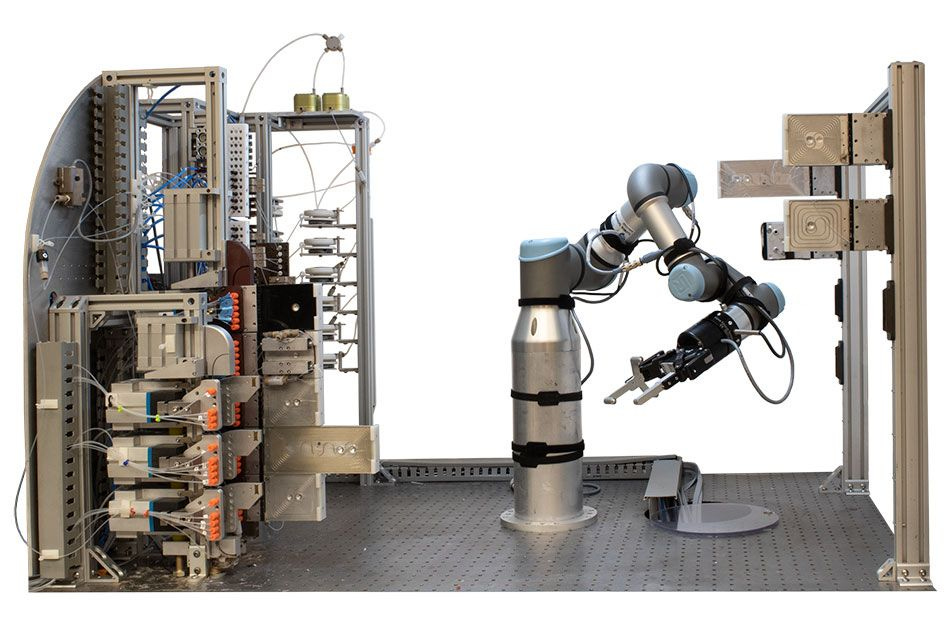
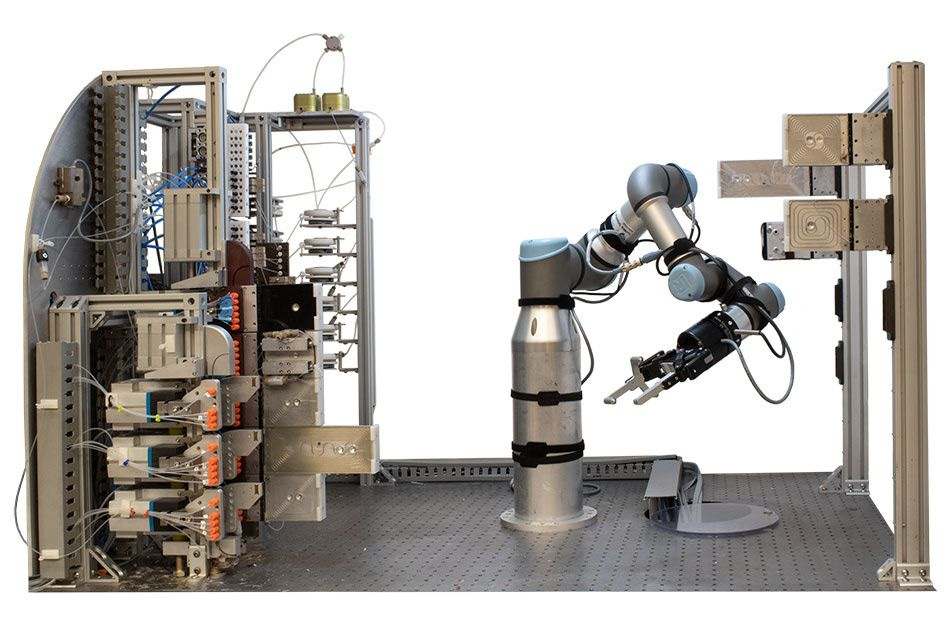
Image credit: Guided by AI, robotic platform automates molecule manufacture
Definition
Robotics involves building and using robots to do tasks that humans usually do.
Robots are great for jobs that are boring, need precision, or are dangerous for people.
They work well in stable environments like factories, but it’s harder for them to operate in changing or busy places.
How Do AI and Machine Learning Help Robots?
AI and Machine Learning (ML) make robots smarter and more adaptable.
With ML, robots use cameras and sensors to see and understand their surroundings.
This helps them make quick decisions, like avoiding obstacles or finding new paths.
Now, robots can handle more complex tasks than before!
Examples of Robots in Action
Industrial Robots:
Used in factories for repetitive or dangerous tasks.
Help with tasks like assembly and inventory management.
Drones:
Flying robots used for taking pictures, monitoring areas, or delivering packages.
Useful for reaching difficult or dangerous places.
Warehouse Robots:
Help sort, stock, and pack items in large warehouses.
Ensure orders are processed quickly and efficiently.
Service Robots:
Assist in hotels, restaurants, and farms.
Can prepare food, deliver items, care for the elderly, and harvest crops
Robotics is making it possible for robots to handle more complex and varied tasks, making them useful in many areas of life.
The Enterprise Imperative for AI
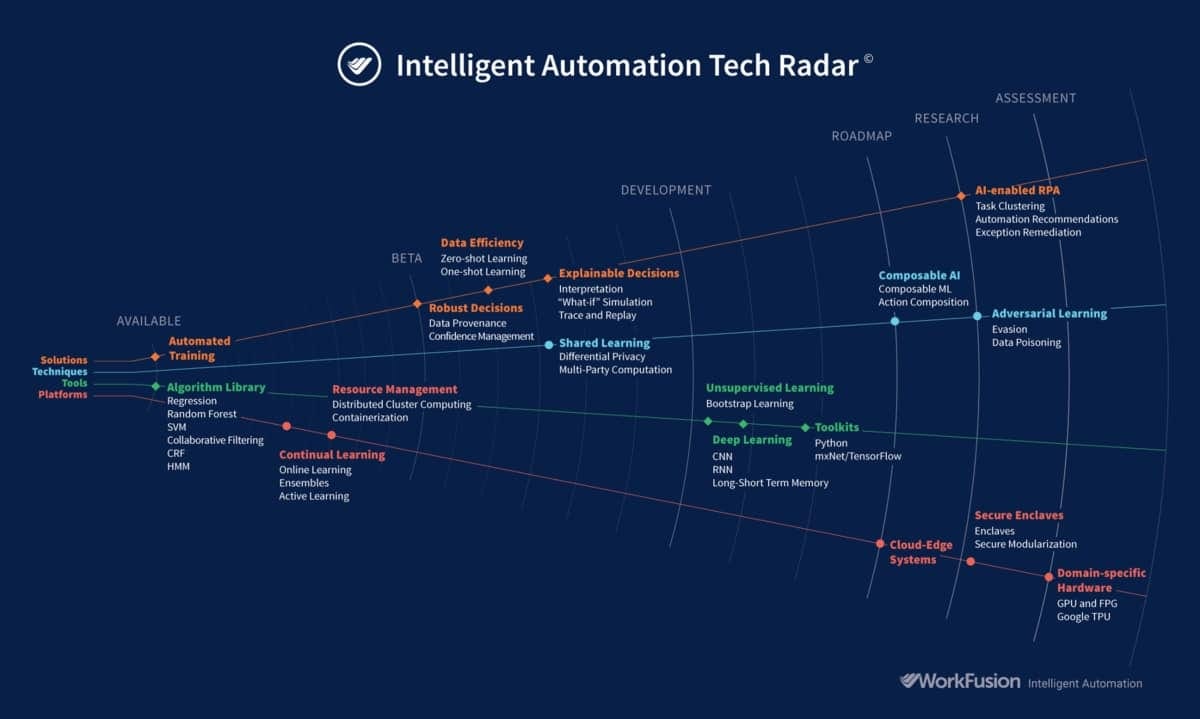
Image Credit: You Asked, We Answered: 5 Top Questions About the Future of Enterprise AI
Enterprise executives must recognize the urgent need to develop an AI strategy to stay competitive. It's essential for leaders to clearly communicate the value and potential of AI across the organization and to invest in helping employees embrace and adapt to these new technologies. Success with AI requires more than just advanced tools; it demands a company-wide commitment, the right mindset, and the active support of all employees.
Unlocking New Capabilities with AI
Business executives need to develop an enterprise-wide strategy to integrate AI services because new technologies like generative AI and custom Large Language Models (LLMs) offer powerful capabilities.
With these tools, companies can automate content creation, generate personalized marketing messages, and even build AI models tailored to their specific business needs.
These advancements enable companies to improve efficiency, create innovative products, and deliver better customer experiences that were previously impossible with traditional methods.
Staying Ahead in a Competitive Market
The business landscape is rapidly changing as competitors quickly adopt AI to enhance their products and services.
Companies are using AI for everything from automating customer support with smart chatbots to developing AI-driven features like personalized recommendations.
Executives must act quickly to integrate these technologies, their companies risk falling behind in the market.
Customers are beginning to expect AI-enhanced experiences, and companies that fail to meet these expectations may lose business to more tech-savvy competitors.
The Risk of Falling Behind
Without a clear AI strategy, companies could be left behind as competitors use AI to improve customer experience, streamline internal processes, and assist employees in their jobs. AI can help personalize customer interactions, automate repetitive tasks, and enhance existing products with smart features. If businesses don’t start experimenting with these technologies now, they may miss out on opportunities to boost productivity and customer satisfaction. To stay competitive, executives must embrace AI as a tool to transform their company and keep up with the fast-paced changes in their industry.
The Enterprise AI Strategy Plan

Image credit, 500 Day Plan Primer
AI isn’t a quick fix; it requires more than just advanced technology and experts. Companies need to change their organization and culture to make AI work effectively. Case Study: In 2013, MD Anderson Cancer Center tried using IBM’s Watson to diagnose and treat cancer. But by 2017, the project was paused after spending $62M without being used on patients. Instead, the center used AI for simpler tasks like recommending hotels for families and predicting which patients might have trouble paying bills.
Centralized Governance:
Company executives should develop an enterprise-wide strategy for AI adoption to ensure that all AI projects are aligned with the organization's overall goals and managed effectively. A centralized governance structure allows the company to maintain consistent standards and practices across all AI initiatives, making sure that projects are prioritized according to their strategic value. This unified approach also helps in setting executive-approved goals, objectives, and tasks, ensuring that every AI effort contributes to the company’s broader vision and avoids duplication or conflicting efforts.
Section 2
Having a central budget for AI projects is crucial for allocating resources efficiently. This approach prevents the fragmentation of funds across different departments and ensures that high-impact projects receive the investment they need. It also enables the company to identify and support “quick win” projects—those that can demonstrate the benefits of AI quickly—helping to build momentum and gain executive and employee buy-in for more complex initiatives in the future.
Section 3
Centralized management of AI initiatives also helps in addressing potential risks, such as data privacy issues or algorithmic bias. By having a dedicated team to oversee these concerns, the company can proactively manage risks and ensure compliance with regulatory standards. Additionally, a unified strategy allows the organization to plan and fund necessary updates to IT infrastructure and data cleansing capabilities, which are foundational for successful AI implementation. It also makes it easier to identify skill gaps and provide targeted training, ensuring that employees are well-equipped to work with new AI technologies.
The Business Value of AI
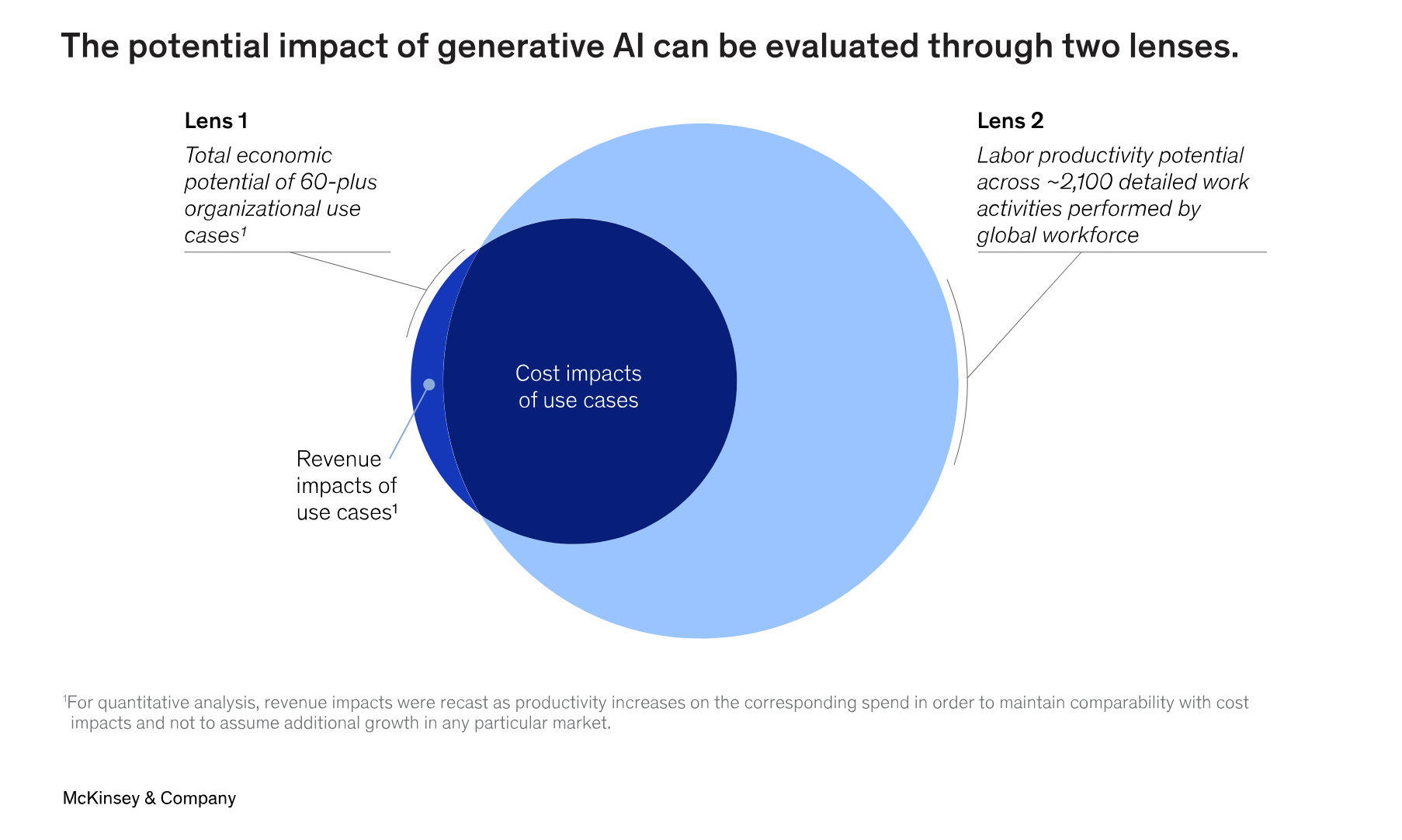
Image credit: The economic potential of generative AI: The next productivity frontier
How AI Can Improve the Value Chain,
Process Automation: AI can handle repetitive tasks more efficiently.
Intelligent Insight: AI can analyze data to provide valuable information.
Intelligent Engagement: AI can improve communication and interactions.
Improving Customer Experience with AI
Business executives should explore how AI can enhance customer interactions by making them more personalized and efficient. AI-driven chatbots and virtual assistants can provide instant support, answering customer inquiries 24/7 without the need for human intervention. For example, an e-commerce company can use AI to offer personalized product recommendations based on a customer’s browsing history and preferences, creating a more engaging shopping experience. Additionally, AI-powered sentiment analysis can help businesses monitor customer feedback across social media and review sites, allowing them to respond proactively to any issues and improve customer satisfaction.
What customers want:
Self-Service: Customers want to solve their own problems quickly.
Omni-Channel Experience: They want to connect with you through multiple channels (like phone, chat, and social media) without repeating themselves.
Shifts in Technology:
Traditional systems like IVR (Interactive Voice Response) and IVA (Intelligent Virtual Agents) are being replaced by AI solutions that offer faster, smarter support.
Enhancing Internal Processes with AI:
AI can significantly streamline internal business operations by automating repetitive tasks and improving workflow efficiency. For instance, AI can automate data entry, invoice processing, and other routine tasks in finance and HR departments, freeing up employees to focus on more strategic activities. AI-driven predictive analytics can also help companies better manage their supply chain by forecasting demand and optimizing inventory levels. By integrating AI into these processes, businesses can reduce errors, save time, and lower operational costs, leading to a more agile and efficient organization.
Boosting Employee Capabilities with AI:
Executives should consider how AI can serve as a tool to enhance employee productivity and decision-making. AI can assist employees by providing real-time data insights, automating complex calculations, and even generating reports with minimal input. For example, in a sales department, AI can analyze customer data to identify high-potential leads, allowing sales teams to prioritize their efforts effectively. AI-powered tools like language models can also help employees draft emails, summarize documents, and conduct research, enabling them to work faster and with greater accuracy.
Enhancing Products with AI Features:
Integrating AI into existing products can add significant value and differentiate a company’s offerings in the market. For instance, a software company could incorporate AI-driven predictive analytics into its product, helping users make data-driven decisions. A consumer electronics company could add voice recognition or AI-powered personal assistants to its devices, making them more user-friendly and interactive. By continuously enhancing products with AI features, businesses can meet evolving customer expectations, increase user engagement, and stay competitive in a rapidly changing market.
The Impact of AI on IT

Image credit: The Impact Of Artificial Intelligence On Software Development
TBD: CIO’s and others….. (Transparency, Trust, Control) …
Retooling and Reskilling: CIOs and IT decision leaders must recognize that integrating AI into their operations will require significant retooling and retraining of their workforce. IT teams will need to acquire new skills in areas like data science, machine learning, and AI ethics to effectively manage and deploy AI tools and platforms such as TensorFlow or Azure AI. This shift will also transform traditional IT roles, as AI takes over routine tasks like network monitoring and data processing. As a result, IT professionals will need to focus more on strategic planning, cybersecurity, and optimizing system performance. Investing in comprehensive training programs and upskilling initiatives is crucial to preparing the workforce for these changes, ensuring that they are equipped to leverage AI technologies and contribute to the organization’s success in a rapidly evolving tech landscape.
Recommendations:
Only use technology the company is ready for
Invest in AI education for all employees
Create a strategy led by leaders, with flexible, small-scale testing
Expect resistance to change
Balance feasibility, time, and value
New Platforms and Systems Architecture
To fully leverage AI, business executives need to evaluate their current IT infrastructure and identify any gaps that might hinder AI adoption. This involves assessing whether existing platforms can handle the high computational demands of AI, such as processing large datasets and running complex machine learning algorithms. In many cases, it may be necessary to upgrade to more powerful servers, integrate cloud computing solutions, or adopt specialized AI hardware like GPUs. Additionally, executives should ensure their systems architecture is flexible enough to integrate new AI tools and technologies without disrupting current operations.
Recommendations:
tbd
New IT Operations
When implementing AI services, CIOs must be aware that AI can significantly transform IT operations by automating and enhancing DevOps processes like testing, monitoring, and incident management. For example, AI can predict potential system failures before they occur, enabling proactive maintenance and reducing downtime. However, this shift requires new tools and processes tailored for AI integration. AI can introduce intelligent operations such as Intelligent Error Prediction, which anticipates system issues; Intelligent Remediation, which can automatically resolve common problems; and Intelligent Maintenance Planning, which optimizes maintenance schedules based on predictive insights. These capabilities can greatly improve system reliability and efficiency, but they demand careful planning and the adoption of specialized AI-driven tools and workflows.
Recommendations:
tbd
New Development Models
Agentic development
TBD
Use cases:
Summarizing a long text response for a user
Sentiment or urgency analysis of input text to prioritize request responses
First draft answer based on company data
Search engine automatic Q&A to refine result
Conversation engine for user input
Reasoning engine based on human guidance
Article comparison
Best solution description for a given question and user context known from historical interactions.
Pattern searching for service inputs unseeable by average human
Recommendations:
TBD
Data and Analytics
A critical step in AI implementation is ensuring that the data used is clean, accurate, and relevant. Executives need to recognize that data cleansing isn’t a one-time task but an ongoing process that requires significant effort and planning. Incomplete or incorrect data can lead to unreliable AI results, potentially harming business decisions. The data analytics team must know when and how to perform data cleansing, which involves removing duplicates, correcting errors, and filling in missing information. Business leaders should allocate appropriate resources and time for these activities to ensure the data used in AI projects is of the highest quality.
AI must have access to quality corporate data, so enterprises should break down organizational silos to ensure cross functional use of data
However, company data can contain sensitive data, and therefore cross functional use must ensure it complies with government regulations (e.g., GDPR)
Additional Concerns
Integration: One of the primary concerns is the complexity of integrating AI with existing IT systems, especially legacy systems that may not be designed to support advanced AI capabilities. For instance, implementing AI-driven analytics in these systems often requires significant data transformation and the development of new APIs to enable smooth communication between the old and new technologies. CIOs must carefully plan these integrations to avoid disruptions and ensure that AI solutions can operate effectively within the current IT environment.
Scalability and performance: Also a crucial consideration. AI workloads can be highly resource-intensive, demanding robust and scalable infrastructure to handle large volumes of data and complex computations. This often means adopting cloud platforms like AWS or Azure that offer scalable resources capable of supporting the heavy data processing needs of AI applications. CIOs should ensure that their infrastructure can scale up or down as needed to accommodate the varying demands of AI workloads, avoiding potential bottlenecks that could hinder the performance of AI services.
Future-proofing: The IT architecture is another critical aspect CIOs need to focus on. As AI technologies rapidly evolve, the IT infrastructure should be flexible enough to adapt to new advancements without requiring constant overhauls. For example, building a cloud-based infrastructure with modular components can make it easier to integrate new AI tools and applications as they become available. This approach not only prepares the company for future innovations but also reduces the time and cost associated with adopting new technologies.
Impact of New Tech: Lastly, CIOs should be aware of how AI is impacting and enhancing emerging technologies like augmented reality (AR), virtual reality (VR), and mixed reality (MR). AI integration with these technologies can unlock new business opportunities and improve user experiences. For example, AI-powered AR glasses, such as those being developed in Meta’s Ego4D project, can assist users with everyday tasks like finding lost items or navigating complex environments. Understanding how AI can be applied to these emerging technologies will help CIOs strategically position their company to capitalize on these innovations while aligning them with the overall business strategy.
The Impact of AI on Society
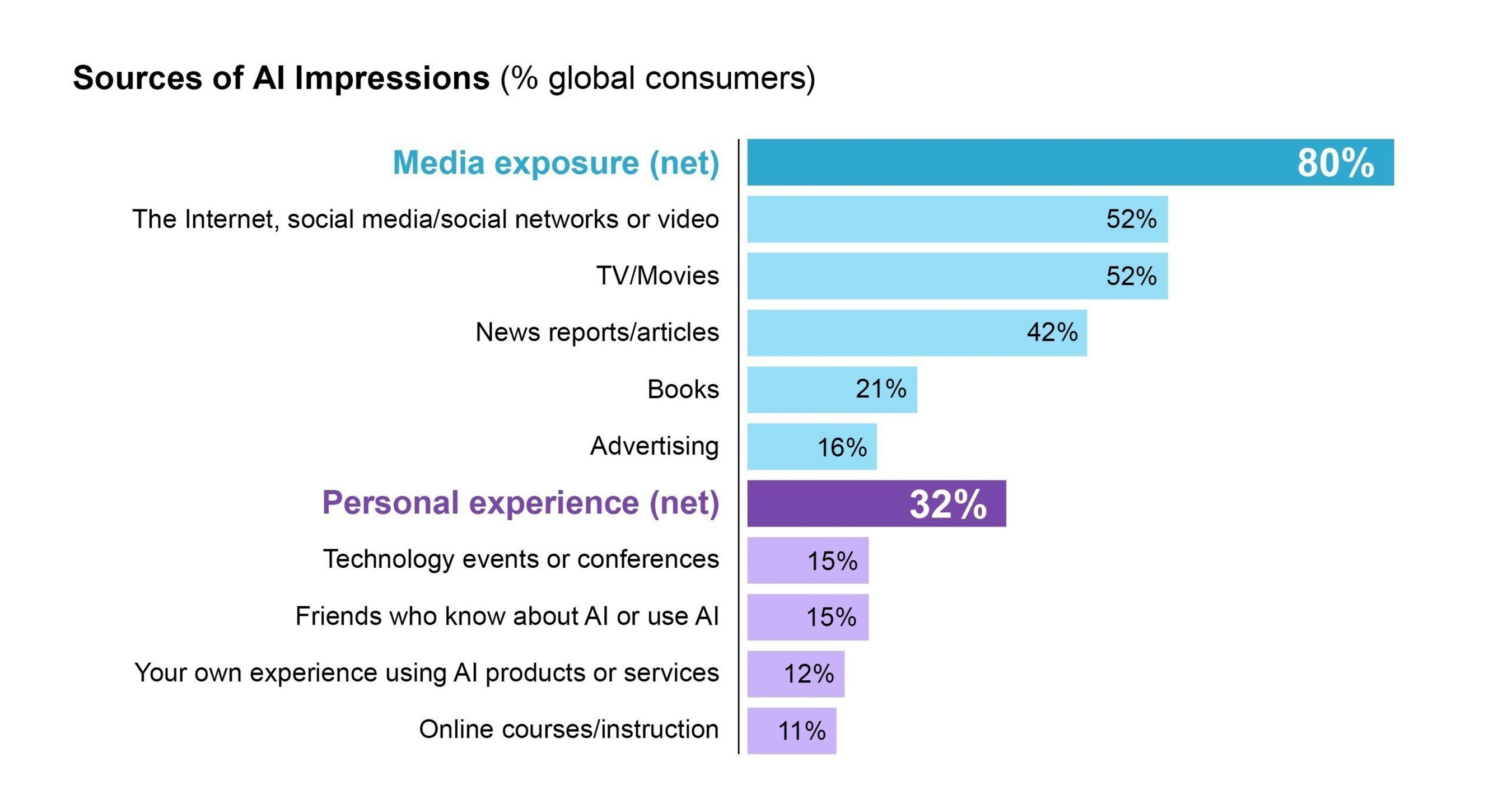
Businesses implementing AI services can create multiple impacts to its employees and to society which executives must understand to ensure they reduce risk and adhere to their social goals.
The Impact of AI on Job Roles
Business executives need to be aware that AI will significantly change job roles within their organizations. While AI can automate repetitive tasks and boost productivity, it may also lead to the displacement of certain jobs. However, rather than simply replacing employees, AI offers an opportunity to upskill the workforce. Companies should focus on reskilling their employees to take on more complex and value-added roles that require human creativity, critical thinking, and emotional intelligence. It’s essential for executives to plan for these changes by investing in training and development programs that prepare their workforce for the evolving job landscape.
AI as a Tool: AI can help with data analysis, making it faster and easier to find insights.
AI as an Assistant: AI-powered assistants, like chatbots, can handle basic customer queries, allowing employees to handle more difficult problems.
AI as a Peer: AI can work alongside employees, providing suggestions and support in real-time.
AI as a Manager: AI can manage simple tasks, like scheduling, freeing up managers for strategic decision-making.
Ethics, Bias, and Fairness in AI
Executives must also understand the ethical implications of AI, particularly around issues of bias and fairness. AI systems learn from data, and if that data is biased or unrepresentative, the AI’s decisions will also be biased, potentially leading to unfair outcomes. This can affect areas like hiring, customer service, and even product recommendations. It’s crucial for businesses to establish guidelines and processes to minimize these risks, such as using diverse datasets, regularly auditing AI models for bias, and involving ethicists in AI project planning. Ensuring that AI systems are fair and unbiased is not just a technical challenge but a moral responsibility that companies need to take seriously.
TBD
Protecting Intellectual Property, Privacy, and Security
As AI becomes more integrated into business operations, protecting intellectual property, data privacy, and security becomes even more critical. AI systems often rely on vast amounts of data, including sensitive customer information, which makes them attractive targets for cyberattacks. Executives must implement robust data protection measures to secure this information and comply with privacy regulations like GDPR. Additionally, companies should be vigilant about safeguarding their AI models and algorithms, as these can be valuable intellectual property that sets them apart from competitors. A comprehensive approach to cybersecurity and data protection is essential to maintaining trust and avoiding legal and reputational risks.
TBD
Transparency, Explainability, and the AI No-Win Scenario
One of the biggest challenges with AI is its “black box” nature, where it’s difficult to understand how AI systems arrive at certain decisions. This lack of transparency can create trust issues, especially in critical areas like healthcare, finance, and law enforcement. Business leaders should advocate for explainable AI (XAI) to make AI decisions more transparent and understandable to both employees and customers. Furthermore, executives must consider the ethical dilemmas posed by AI, such as the “No-Win Scenario” in autonomous vehicles where the AI must choose between two harmful outcomes. Developing ethical frameworks and clear policies for handling such scenarios is crucial to maintaining public trust and ensuring responsible AI use.
TBD
Supporting Government Regulations
As AI technologies evolve, so too will government regulations aimed at ensuring their ethical and safe use. Executives need to stay informed about current and upcoming regulations related to AI, such as data protection laws, transparency requirements, and industry-specific guidelines. Being proactive in complying with these regulations not only helps avoid legal penalties but also positions the company as a responsible and forward-thinking player in the industry. Supporting and engaging with regulatory bodies can also help shape policies that benefit both society and businesses, ensuring that AI development proceeds in a way that is fair, ethical, and beneficial for all.
TBD
The Impact of AI on Government Operations
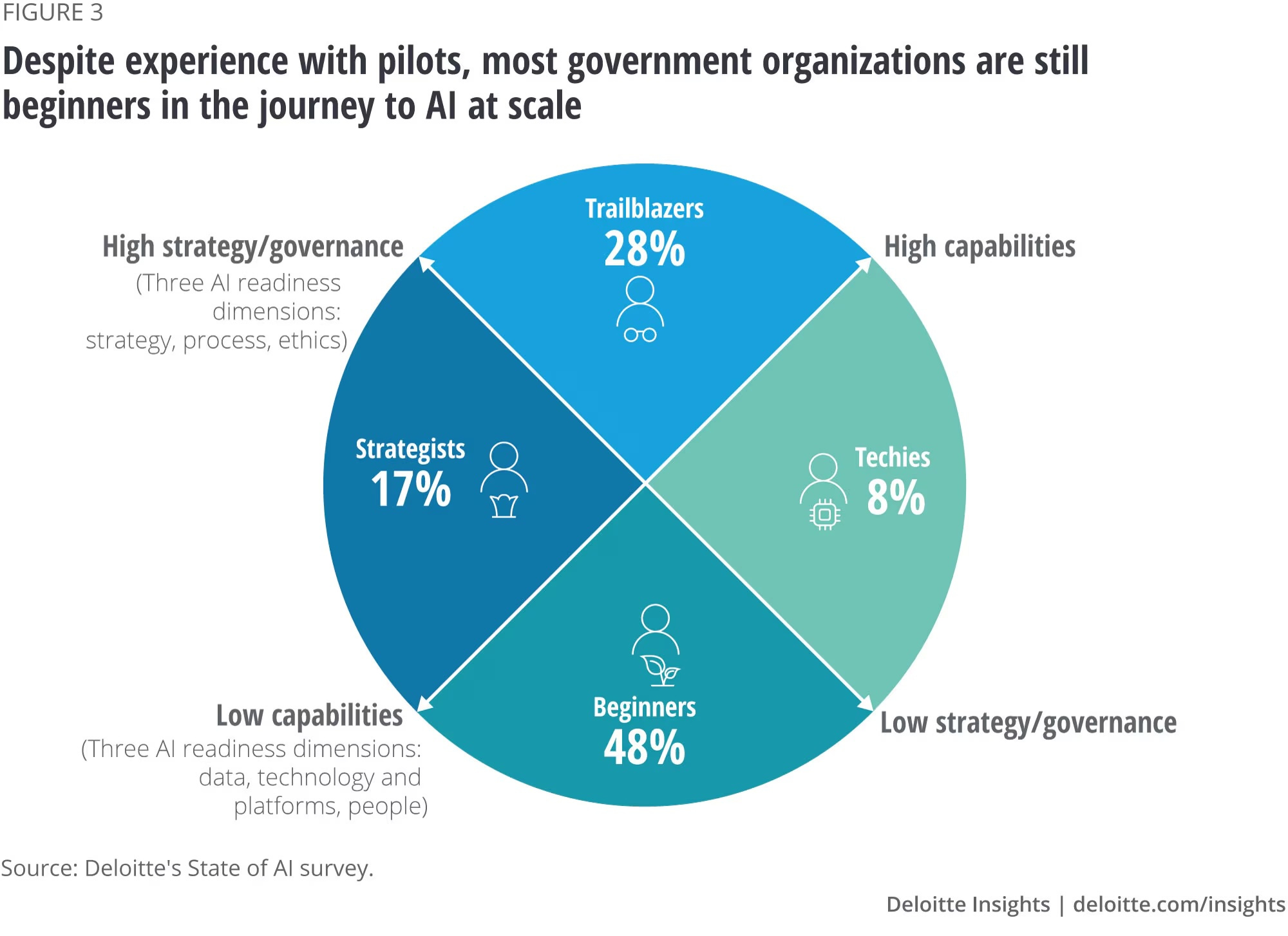
Image credit: Scaling AI in government
National, Regional, Local governments can improve their value to citizens through multiple uses with AI.
Improving citizen self service
Adding AI applications to government service organizations is transforming how agencies operate and deliver services to the public. AI can automate routine tasks, such as data entry or document processing, for example, AI chatbots can handle common inquiries from citizens, freeing up human agents to tackle more challenging cases. This not only improves efficiency but also enhances the overall quality of service provided to the public.
TBD
Increasing the efficiency and knowledge
AI also enables government agencies to better manage and analyze vast amounts of data, leading to more informed decision-making. With the help of AI tools agencies can quickly extract insights from massive datasets, such as satellite images or climate data, to address issues ranging from disaster response to environmental protection. This ability to harness data effectively can significantly improve the speed and accuracy of government responses to critical events.
TBD
Ensuring cybersecurity
AI is also playing a crucial role in enhancing government cybersecurity efforts. AI systems can identify vulnerabilities in code and detect potential cyber threats much faster than human analysts alone. Initiatives like DARPA’s AI Cyber Challenge show how AI can be used to protect critical infrastructure and national security by proactively identifying and addressing security risks. This is especially important as cyber threats continue to evolve and become more sophisticated.
TBD
New dangers for government operations
However, implementing AI in government requires careful planning and ethical considerations. Agencies need to ensure that AI systems are transparent, unbiased, and used responsibly. Collaboration, experimentation, and ongoing evaluation will be essential as government organizations explore the potential of AI to improve their services and fulfill their missions more effectively.
TBD
The Dangers to Avoid

Image credit: How businesses can avoid the dark side of AI
Executives face several barriers when integrating AI into their processes and products. Challenges include the difficulty of adapting current systems, high costs for technology and expertise, and a lack of understanding among managers about how AI works. Additionally, there may be a shortage of skilled staff and resources to train employees. Lastly, AI can be overhyped, making it hard to identify realistic opportunities and effective applications.
Lack of Executive Vision: Without a clear vision from leadership, AI projects can lack direction and fail to align with overall business goals.
Not Defining Quick Wins: Focusing only on long-term projects without identifying quick wins can lead to frustration and loss of support from stakeholders.
Poorly Defined Analytics Strategy and Organization: An unclear strategy and disorganized analytics team can result in disconnected efforts, inefficiencies, and missed opportunities.
Neglecting Data Cleansing: Failing to clean and prepare data properly can lead to inaccurate AI outcomes, undermining trust in AI initiatives.
Using Incorrect Platforms: Choosing platforms that don’t fit the organization’s needs can cause technical issues, slow progress, and increase costs.
Ignoring Risk, Ethics, and Regulations: Overlooking these crucial areas can lead to legal problems, ethical dilemmas, and damage to the company’s reputation.
Inability to Future Plan: As new technologies appear, existing funded projects may become quickly outdated. Therefore, an Enterprise AI Strategy Plan must include an agile process to quickly adapt to change.
Business executives should carefully plan and manage these aspects to ensure a successful and sustainable AI implementation.
Additional References
History of AI
A Layman’s Guide to Neural Networks, Justin Stoltzfus, 2022
Alan Turning, Computing Machinery and Intelligence, 1950
Artificial Intelligence vs Machine Learning: What’s the difference?, Clara Piloto
Crowd Forge, Crowdsourcing Complex Tasks,2011
CrowdForge, a research project at Carnegie Mellon University
Deep Learning vs Machine Learning, a Comparison, Adobe
Early Artificial Intelligence Projects, A Student Perspective, 2006
Early Artificial Intelligence Projects: A Student Perspective, Heather Knight, 2006
Frames of Mind: The Theory of Multiple Intelligences, Gardner, Howard1983
Gartner’s Pace layered Application Transformation Strategy
Generative AI vs other Types of AI, Adobe
Harvard Business Review: Artificial Intelligence for the Real World, 2018
Harvard Business Review: Building the AI Powered Workforce, 2019
HarvardEX Data Science Textbook
How the “third AI wave” is transforming Government ops, Scoop News Group, 2024
Marvin Minsky, “Steps towards AI”, 1961
Mckinsey: Ten red flags signaling your analytics program will fail
Meet the 9 Wikipedia bots that make the world’s largest encyclopedia possible, Luke Dormehl, 2020
MIT Center for Collective Intelligence
MIT Computer Science and & Artificial Intelligence Lab
Newell and Simon's Logic Theorist: Historical Background and Impact on Cognitive Modeling
Paul Werlbross, 1974, Harvard PHd dissertation on Back propagation
Stanford General Reading List on AI, 1985
The AI Republic: Building the Nexus Between Humans and Intelligent Automation
The Future of Jobs Report, 2023 Infusing Digital Responsibility into Your Organization, by Tomoko Yokoi, Lazaros Goutas, Michael Wade, Nicolas Zahn and Niniane Paeffgen, 2023
The History of AI, Rockwell Anyoha, 2017
The Rocky History of AI (opening section)
What managers need to know about artificial intelligence, Kiron, David, 2017
Why AI isn’t the Threat we Think it is, Mark Esposito, Terence Tse, 2018
AI in Business and Society
A short history of jobs and automation, 2020
AI bias: Why it’s so damn hard to make AI fair and unbiased, Sigal Samuel, 2022
AI Taking Over Jobs: What to Know About the Future of Jobs, Matthew Urwin, 2024
Governance of Superintelligence, 2023
MIT Examination of Work in an era of intelligent machines
Protecting Privacy in an AI Driven World, Cameron Kerry, 2020
Research shows AI is often biased. Here's how to make algorithms work for all of us, 2021
The Dumb Reason Your AI Project Will Fail (link old)
To fight COVID-19, governments need to rethink the value of informationLinks to an external site.
What Lawyers Want Everyone to Know about AI Liability, Lisa Morgan, 2021
Why Ethical AI won’t Catch on Anytime Soon, David Roe, 2021
Why transparency in AI matters for Business, Mark Labbe, 2021
Machine Learning
39 Machine Learning Examples and Applications to Know, Gordon Gottsegen
Behind The Scenes of The Netflix Recommendation Algorithm, 2021
Deep Learning for Recommender Systems: A Netflix Case Study
Facebook use of Image recognition
Five Rules for Fixing AI in Business, 2022
How Stitch Fix Uses Data Science and Machine Learning to Deliver Personalization at Scale
Machine Learning For Dummies Cheat Sheet, John Paul Mueller and Luca Massaron, 2021
Machine Learning For Medical Image Analysis - How It Works
Michael E Porter, From Competitive Advantage to Corporate Strategy, 1987
New AI tool improves cognitive testing, Nancy DuVergne Smith, 2017
PayPal Feeds the DL Beast with Huge Vault of Fraud Data, Alex Woodie, 2019
Powered by TensorFlow: Airbnb uses machine learning to help categorize its listing photos
Take a Virtual Ride in Mobileye's Autonomous Vehicle
Tapping the Power of Unstructured Data, Tam Harbert, 2021
The economic potential of generative AI: The next productivity frontier, 2023
Using machine learning for insurance pricing optimization,Kaz Sato 2017
What is Artificial Intelligence in 2024? Great Learning Editorial Team, 2024
Natural Language Processing
DALL·E: Creating images from text, 2021
Gartner Peer Insights: products In Data Science and Machine Learning Platforms Market
GPT-3 powers the next generation of apps, 2021
Introduction to Natural Language Processing (NLP), Niklas Donges, 2023
Powering next generation applications with OpenAI Codex, 2022
Top business applications of natural language processing, Shruti, 2022
Two NLP Use-Cases in Drug Discovery and Clinical Trials, Daniel Faggella, 2022
What is GPT-3?, Ben Lutkevich, Ronald Schmelzer, 2023
Why finance is deploying natural language processing, Tracy Mayor, 2020
Robotics
After Disaster Strikes, Robots to the Rescue
CNET News - Meet the robots making Amazon even faster
Cobots vs. industrial robots: what are the differences?, Cobot Trends Staff
Customer Success Story: Moduform
Extend your data capture apps with RPA
How Service Robots are Transforming the Enterprise
How to control robots with brainwaves and hand gestures, Adam Conner-Simons, 2018
How to explain Robotic Process Automation (RPA) in plain English, Kevin Casey, 2020
Inside Spyce Restaurant, Where Robots Make The Food | TODAY
Intelligent Automation: A Game-changer for Banking Operations (Loan Processing)
Robot food runner: Massachusetts restaurant's high-tech solution for staff shortage
Robot hand is soft and strong, Rachel Gordon, 2019
Robots rise to meet the challenge of caring for old people, Neil Savage, 2022
See Robot Spot 3D-Map a Ford Transmission Factory, Roberto Baldwin, 2020
Soft robotic fish swims alongside real ones in coral reefs, Adam Conner-Simons, 2018
Teaching robots to learn how to learn, 2018
The new wave of robotic automation, Daniel de Wolff, 2021
The Road to Intelligent Process Automation, Ben Lorica and Jenn Webb
This robotic surgery is so intricate it can stitch a peeled grape back together
This wearable robotic arm can hold tools, pick fruit, and punch through walls
Walmart unveils robot-run warehouse for online grocery orders, Bloomberg News, 2020